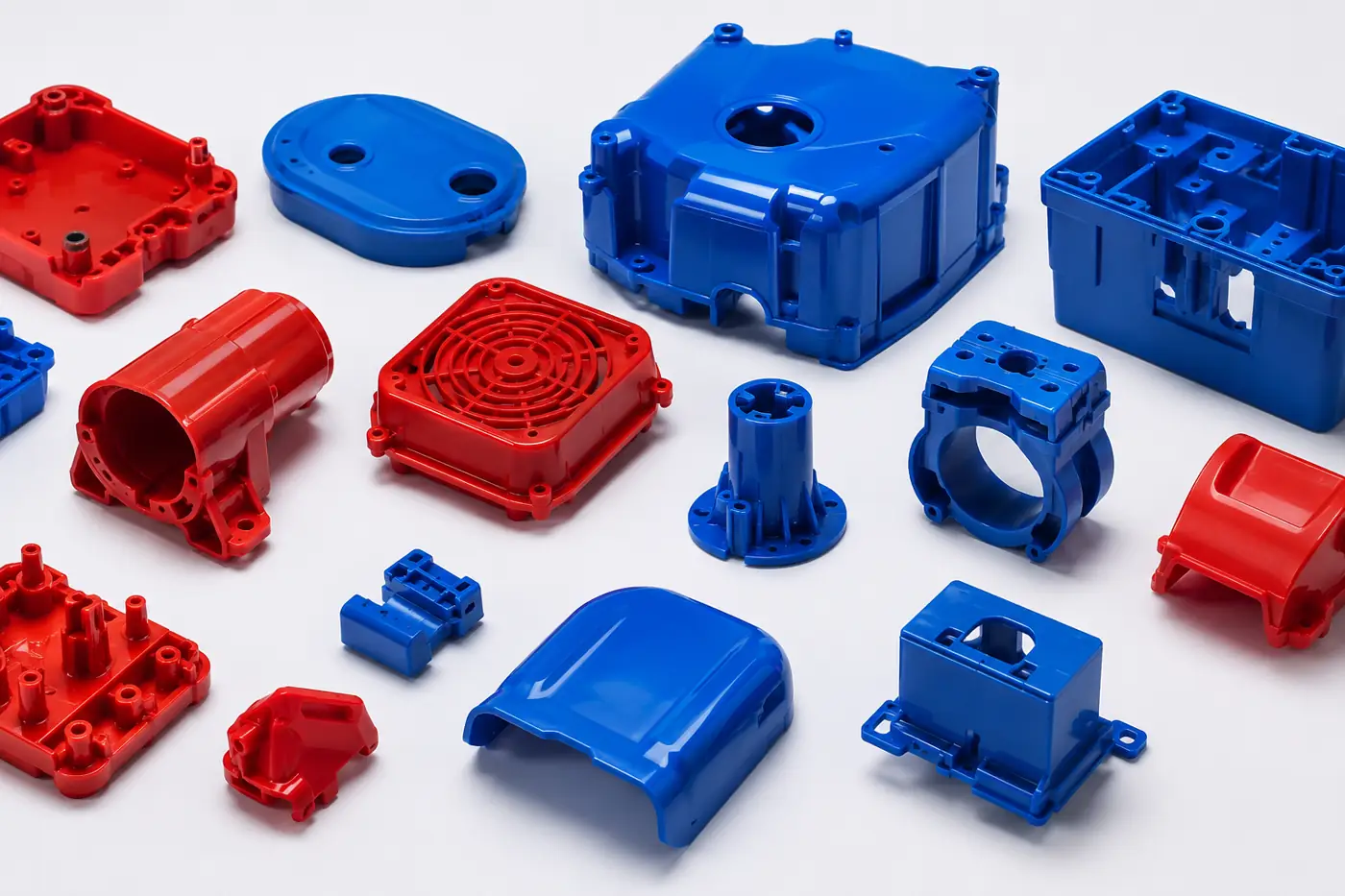
Non-warping is critical
HDPE crystallises strongly, so nucleating pigments distort crates, caps and containers; insist on grades proven warp-free in HDPE.
 Pigments by Source From India
Applications
Pigment recommendations for hdpe with technical checks and export enquiry support.
High-density polyethylene is processed at relatively high melt temperatures and is strongly semi-crystalline, which makes organic pigment selection about both heat stability and dimensional control. Many pigments that are fine in flexible film can nucleate HDPE crystallisation and warp rigid parts like crates, drums and pipe. Buyers should specify heat-stable, non-warping grades verified in HDPE, confirm good dispersion at low let-down and check that colour does not shift between thick and thin sections. Masterbatch delivery is common for uniform colour in blow-moulded and injection HDPE goods.
At a glance
HDPE crystallises strongly, so nucleating pigments distort crates, caps and containers; insist on grades proven warp-free in HDPE.
HDPE runs hotter than LDPE, so pigments must hold shade and strength across the higher melt and longer residence at thick walls.
Rigid HDPE parts need well-dispersed pigment to avoid specks and to keep colour even between thick and thin wall sections.
Pre-dispersed masterbatch gives more uniform colour in blow-moulded and injected HDPE than dry powder, cutting streaks and unmixed specks.
Recommended pigments
A starting shortlist of export-grade organic pigments relevant to Pigments for HDPE. Open any grade for shade, fastness and packing detail, or send your requirement for a matched recommendation.
Solvent-compatible paste for industrial paints and ink systems.
View export grade Yellow PigmentsHigh-tinctorial yellow selected for general industrial demand.
View export grade Red PigmentsNaphthol red with balanced brightness and industrial usability.
View export grade Pigment PastesDispersion paste designed for polyester resin coloration.
View export grade Green PigmentsChlorinated phthalocyanine green for durable industrial coloration.
View export gradeExplore more
Answers
HDPE is more crystalline and rigid, so any pigment that alters crystallisation changes shrinkage and warps the part visibly. LDPE is softer, less crystalline and usually made into flexible film, where minor dimensional change is tolerated. HDPE therefore demands specifically warp-tested, non-nucleating pigment grades.
Heat-stable, non-warping organic pigments, often selected phthalocyanines and high-performance azo and condensation grades, are used where inorganics cannot give the shade. For strong exterior applications, verify light and weather fastness too, since crates and drums often see outdoor storage and sunlight.
HDPE typically processes at higher melt temperatures than LDPE and is comparable to or below PP depending on grade and method. The practical point is to match the pigment's heat rating to your actual process, since blow moulding, injection and pipe extrusion each impose different heat and residence conditions.
Sometimes, because both are semi-crystalline polyolefins needing heat-stable, non-warping grades, but not always. PP often runs hotter and has its own warpage sensitivity. Confirm each pigment is validated separately in HDPE and PP rather than assuming polyolefin performance transfers directly between them.
Buyer knowledge base
A buyer-first summary of pigment selection, quality documentation and export logistics, so technical and commercial teams work from the same brief.
Sourced at origin through an in-house export desk — one contact from sample to shipment.
High tinting strength means less pigment per batch and cleaner, more economical shades.
For outdoor use, phthalocyanine and DPP grades keep colour through sun and weather.
Bags, cartons, pallets and labels planned for clean warehouse handling and clearance.