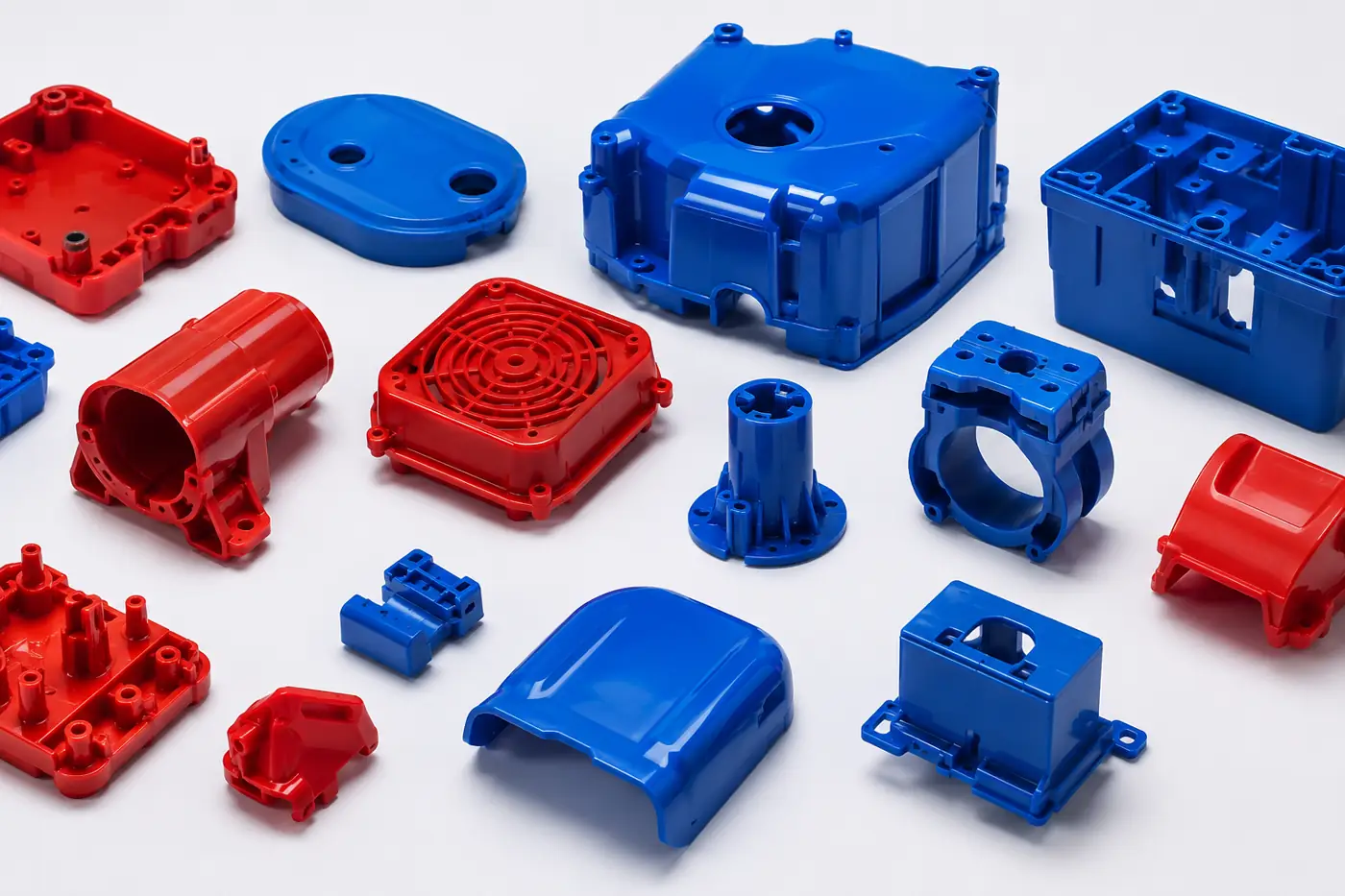
Match heat to resin
Processing temperatures vary widely by polymer, so specify a pigment heat rating that covers your hottest resin and residence time.
 Pigments by Source From India
Applications
Pigment recommendations for plastic injection moulding with technical checks and export enquiry support.
Injection moulding colours a huge range of polymers, so organic pigment selection depends heavily on the resin, its processing temperature and part geometry. Pigments must be heat stable for the melt, must not migrate or bloom in the finished part, and critically must not cause warpage or distortion in semi-crystalline polymers. Buyers should confirm the pigment's heat rating against the resin's processing window, its dispersion behaviour at short residence times, and whether a masterbatch or dry-blend delivery gives more consistent colour than powder in a fast cycle.
At a glance
Processing temperatures vary widely by polymer, so specify a pigment heat rating that covers your hottest resin and residence time.
In semi-crystalline resins, some pigments nucleate crystallisation and distort parts; choose non-warping grades for dimensionally critical mouldings.
Confirm pigments resist blooming and plate-out so moulded surfaces stay clean and adjacent parts are not stained in service.
Pre-dispersed masterbatch usually gives more uniform colour at fast cycles than dry powder, reducing streaking and specking in thin sections.
Recommended pigments
A starting shortlist of export-grade organic pigments relevant to Pigments for Plastic Injection Moulding. Open any grade for shade, fastness and packing detail, or send your requirement for a matched recommendation.
High-tinctorial yellow selected for general industrial demand.
View export grade Red PigmentsNaphthol red with balanced brightness and industrial usability.
View export grade Pigment PastesDispersion paste designed for polyester resin coloration.
View export grade Green PigmentsChlorinated phthalocyanine green for durable industrial coloration.
View export grade Yellow PigmentsHigh-performance yellow for demanding coating and plastic requirements.
View export gradeExplore more
Answers
Each resin has its own processing temperature, crystallinity and chemistry, which dictate whether a pigment is heat stable, migration free and warp safe in that system. The same pigment can be ideal in one polymer and unusable in another, so selection always starts from the specific resin.
In semi-crystalline polymers like polyolefins and nylon, certain organic pigments act as nucleating agents, changing shrinkage and causing warpage. Specify grades tested as non-warping in your resin, especially for flat, thin or dimensionally tight parts, and validate on production tooling.
Often yes. Masterbatch pre-disperses pigment in a carrier, giving consistent colour, less dust and fewer specks at short injection cycles. Powder and dry-blend can work for large batches and cost savings, but demand good mixing and screw design to avoid streaking.
Plate-out is pigment or additive depositing on mould surfaces and screws over a run, causing gloss defects and colour drift. Migration-prone pigments worsen it. Choosing low-migration grades and correct dispersion reduces mould cleaning downtime and keeps colour consistent across a long production run.
Buyer knowledge base
A quick orientation for buyers new to Indian pigment supply — what to specify, what to expect and how to move fast.
REACH and RoHS declarations and correct HS codes prepared for your market's customs.
Approve shade, strength and dispersion on a sample before any production quantity.
25 kg bags, palletised and batch-labelled, cleared under HSN 3204 17 90 for smooth customs.
Guidance on oil absorption and let-down, plus ready-to-use pastes where direct handling helps.