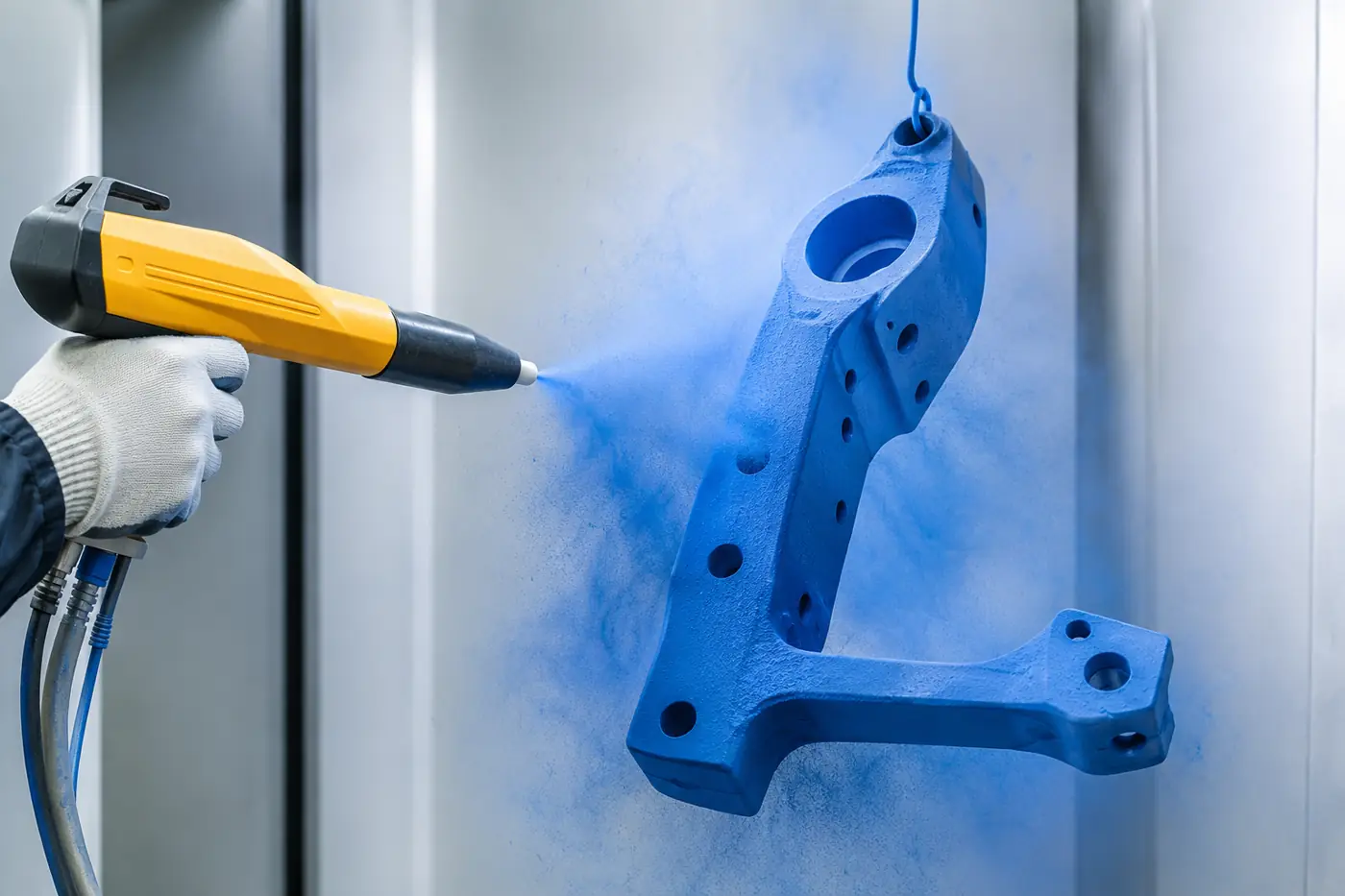
Stoving heat stability
Powder cures at high bake temperatures, so select pigments that hold shade through the full stoving schedule without darkening or shifting hue.
 Pigments by Source From India
Industries
Organic pigments for powder coatings sourced from India with grade selection, documents, and export support.
Powder coatings are cured by baking at elevated temperature, so pigments must withstand the stoving schedule without shade shift, and they must be compatible with dry extrusion compounding. Organic pigments give bright, clean colours that inorganics cannot, but heat and weather fastness govern selection, especially for exterior architectural finishes. Buyers sourcing from India should confirm heat stability across their full cure window, weather fastness for outdoor use, and behaviour during melt-mix extrusion. Because powder is applied dry and electrostatically, pigment must not impair flow, charging or film appearance on the finished part.
At a glance
Powder cures at high bake temperatures, so select pigments that hold shade through the full stoving schedule without darkening or shifting hue.
Architectural powder faces years of sun and rain; use high-performance organics with proven weathering so colour and gloss survive outdoor service.
Pigment is melt-mixed during compounding, so confirm it disperses in the resin melt and tolerates extrusion heat and shear without degradation.
Since powder is applied electrostatically, verify the pigment does not disrupt powder flow, tribo-charging or the smoothness of the cured film.
Recommended pigments
A starting shortlist of export-grade organic pigments relevant to Pigments for Powder Coatings. Open any grade for shade, fastness and packing detail, or send your requirement for a matched recommendation.
Chlorinated phthalocyanine green for durable industrial coloration.
View export grade Yellow PigmentsHigh-performance yellow for demanding coating and plastic requirements.
View export grade Orange PigmentsDiarylide orange used for inks, textiles, and industrial colorants.
View export grade Pigment PastesWater-dispersible pigment paste for coatings and textile systems.
View export grade Yellow PigmentsBright green-shade yellow for offset ink and coating applications.
View export gradeExplore more
Answers
Powder cures by baking at elevated temperature for a set dwell, and any heat-sensitive pigment shifts shade or darkens during that stoving. Select organics rated above your cure temperature, and always bake a test panel at production conditions to confirm the final colour matches the approved standard before scaling up.
High-performance grades with strong weathering, such as chlorinated phthalocyanines, quinacridones and DPP reds, suit exterior architectural work. They resist UV fade, chalking and gloss loss over years outdoors. Reserve lower-fastness organics for interior or short-life items, and request outdoor exposure data for any exterior specification.
Powder pigments are dispersed by melt-mixing in an extruder, not in liquid, so they must wet and distribute in the molten resin under heat and shear. Choose grades known to disperse well in powder systems; poor dispersion leaves specks, weak colour or uneven charging on the finished electrostatically applied film.
Yes, indirectly. Pigment loading and type influence powder flow and how the particles hold electrostatic charge, which affects transfer efficiency and film build. Confirm the pigment does not impair tribo or corona charging, and test application on production equipment to ensure even coverage and a smooth cured surface.
Buyer knowledge base
The essentials behind a pigment order: chemistry matched to end use, documents in order, and packing built for your destination.
For plasticised and polyolefin systems, grades are chosen to resist blooming and plate-out.
REACH and RoHS declarations and correct HS codes prepared for your market's customs.
Approve shade, strength and dispersion on a sample before any production quantity.
25 kg bags, palletised and batch-labelled, cleared under HSN 3204 17 90 for smooth customs.