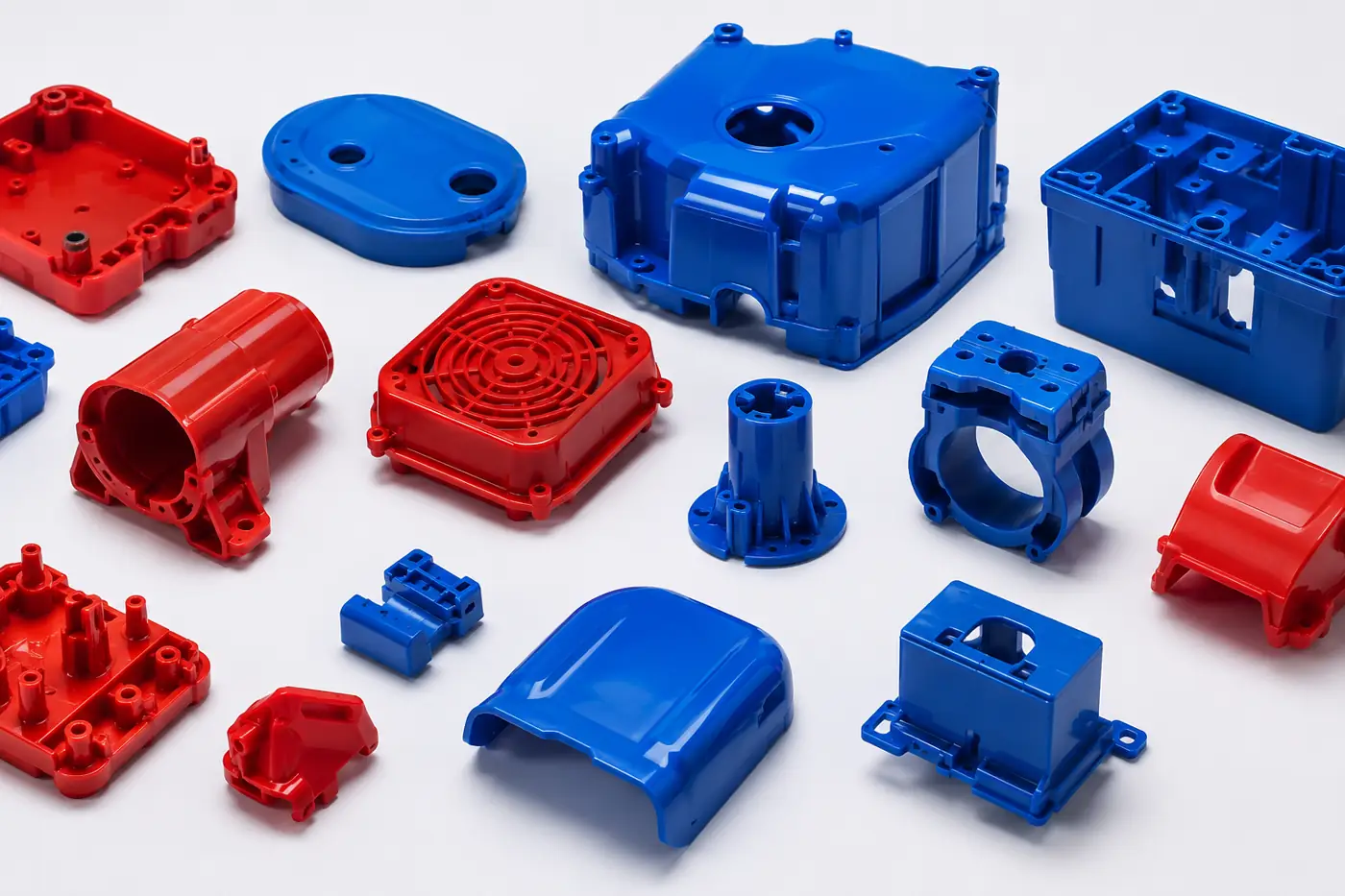
Even colour across walls
Blow-moulded walls vary in thickness, so well-dispersed pigment is needed to keep colour uniform between thick base and thin shoulders.
 Pigments by Source From India
Applications
Pigment recommendations for blow moulding with technical checks and export enquiry support.
Blow moulding produces hollow parts like bottles, containers and drums, mostly from polyethylene and PET, where wall thickness varies and stretch is involved. Organic pigments must be heat stable for the melt, non-warping in polyolefin containers, and, for bottles, must not affect clarity or stretch behaviour unduly. Migration control matters where containers hold liquids or consumer products. Buyers should confirm dispersion at low let-down for even wall colour, warp-safe grades for rigid HDPE containers, and, in PET bottles, heat-stable grades that survive the higher processing temperature without hazing.
At a glance
Blow-moulded walls vary in thickness, so well-dispersed pigment is needed to keep colour uniform between thick base and thin shoulders.
Rigid HDPE bottles and drums warp if pigments nucleate crystallisation, so specify non-warping grades for dimensionally stable containers.
Transparent tinted PET bottles need pigments that colour without hazing, preserving the see-through clarity buyers expect in beverage packaging.
Containers hold liquids and goods, so choose low-migration pigments that will not bleed into contents or affect product safety.
Recommended pigments
A starting shortlist of export-grade organic pigments relevant to Pigments for Blow Moulding. Open any grade for shade, fastness and packing detail, or send your requirement for a matched recommendation.
Chlorinated phthalocyanine green for durable industrial coloration.
View export grade Yellow PigmentsHigh-performance yellow for demanding coating and plastic requirements.
View export grade Orange PigmentsDiarylide orange used for inks, textiles, and industrial colorants.
View export grade Pigment PastesWater-dispersible pigment paste for coatings and textile systems.
View export grade Yellow PigmentsBright green-shade yellow for offset ink and coating applications.
View export gradeExplore more
Answers
Blow-moulded parts have thick and thin regions, and colour looks deeper where the wall is thicker. Good pigment dispersion and correct let-down keep the shade visually uniform. Poor dispersion exaggerates the difference and shows specks, so even, finely dispersed pigment is important for consistent container appearance.
Yes. Rigid HDPE bottles, jerrycans and drums can distort if a pigment nucleates crystallisation and changes shrinkage unevenly. Non-warping grades keep containers dimensionally true so they seal, stack and fill correctly. This is especially important for necks, handles and flat panels on the container.
PET processes at higher temperatures and is often used for clear bottles, so pigments must be more heat stable and must not haze transparent tints. Polyethylene containers instead prioritise warpage control. The higher PET processing window narrows the usable pigment set toward more heat-stable grades.
Bottles and containers hold liquids, foods and consumer products, so pigments that migrate could bleed into contents or to the outer surface. Low-migration grades keep colour in the wall and avoid contaminating what the container holds, which matters for both appearance and product-contact safety.
Buyer knowledge base
Everything a procurement team checks before a pigment order — technical fit, compliance documents, packing and lead time — in one short brief.
For outdoor use, phthalocyanine and DPP grades keep colour through sun and weather.
Bags, cartons, pallets and labels planned for clean warehouse handling and clearance.
TDS, SDS/MSDS and batch COA, plus REACH and RoHS declarations issued on request.
Heat, light, weather, solvent and migration resistance matched to the end use, not over-specified.