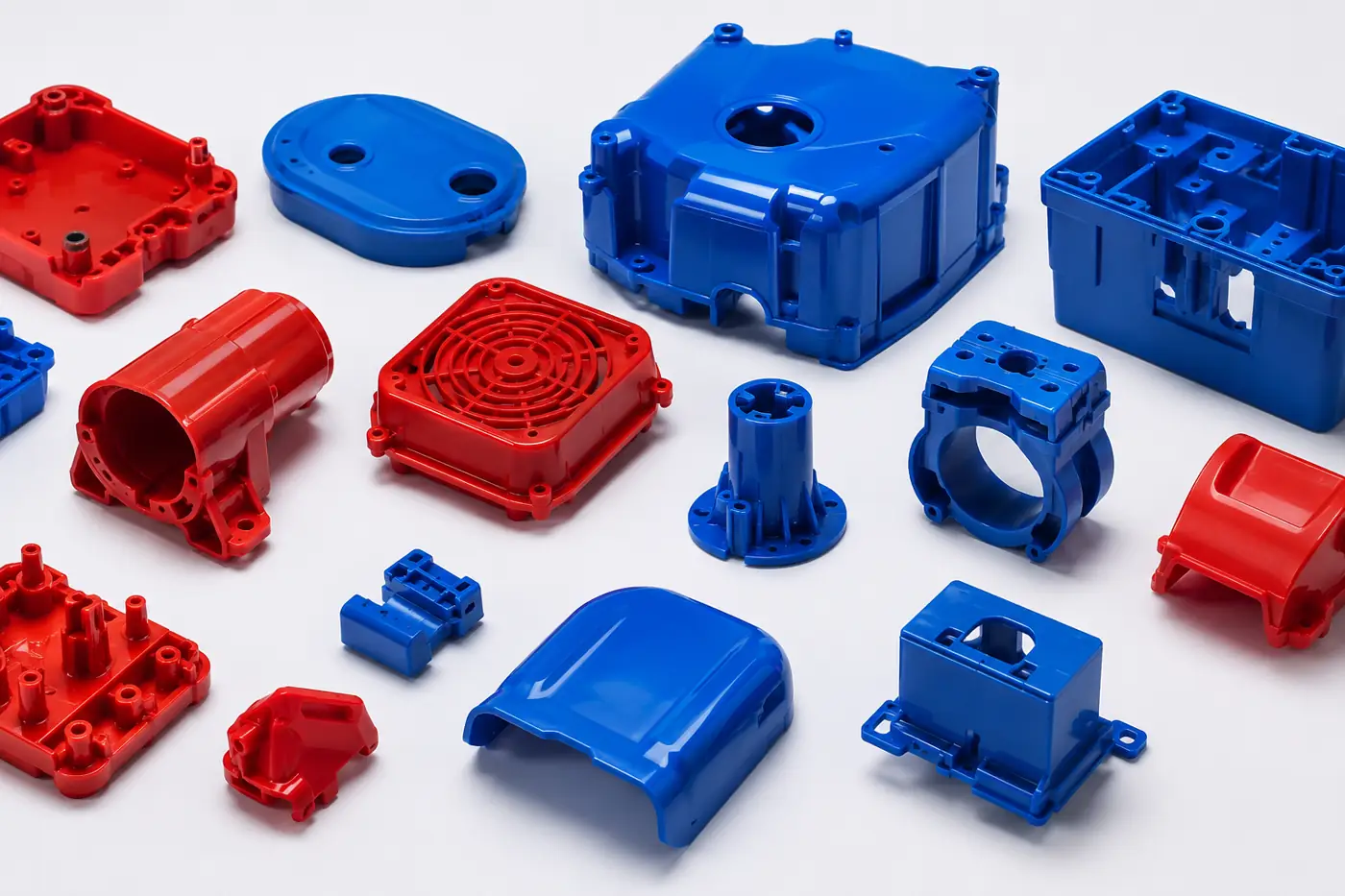
Long-cycle heat stability
Rotomoulding holds resin at heat far longer than injection, so pigments need heat stability to survive the extended cycle without darkening.
 Pigments by Source From India
Applications
Pigment recommendations for rotational moulding with technical checks and export enquiry support.
Rotational moulding makes large hollow parts like tanks, tanks, playground equipment and containers, typically from polyethylene, using long heating cycles at moderate temperatures with powder resin. The extended residence at heat means organic pigments must have strong heat stability to survive without shade shift, while the powder process demands dry-blend compatibility and even distribution. Many parts are outdoor, so weather fastness is important. Buyers should confirm long-cycle heat stability, non-warping behaviour for large flat panels, good dry-blend dispersion, and outdoor durability for tanks and equipment exposed to sunlight.
At a glance
Rotomoulding holds resin at heat far longer than injection, so pigments need heat stability to survive the extended cycle without darkening.
Powder resin is dry-blended or compounded, so pigments must distribute evenly to avoid streaks and colour variation across large parts.
Tanks and play equipment stay outdoors, so specify weatherfast pigments that resist fading over years of continuous sun exposure.
Big flat surfaces show distortion easily, so use non-warping grades to keep tanks and panels dimensionally stable after cooling.
Recommended pigments
A starting shortlist of export-grade organic pigments relevant to Pigments for Rotational Moulding. Open any grade for shade, fastness and packing detail, or send your requirement for a matched recommendation.
Red-shade alpha blue with dependable dispersion for inks and coatings.
View export grade Yellow PigmentsDiarylide yellow orange shade for plastics and heat-sensitive systems.
View export grade Red PigmentsDPP red for premium weather-resistant coatings and plastics.
View export grade Pigment PastesPU-compatible pigment paste for industrial coatings and elastomers.
View export grade Yellow PigmentsEconomical diarylide yellow used in inks and industrial color systems.
View export gradeExplore more
Answers
Rotomoulding heats polymer powder for long cycles so it fuses inside the mould, exposing pigment to heat far longer than fast injection cycles. Even at moderate temperatures, this extended residence can degrade weak pigments. Grades must be validated for the full rotomoulding cycle, not just peak temperature.
Pigment is typically dry-blended with the polyethylene powder or, for best results, compounded into pre-coloured powder. Dry blending is simple and low cost but risks streaking if distribution is poor. Compounded colour gives more uniform results on large parts. The method affects the evenness of the final colour.
Many rotomoulded products, such as water tanks, tote bins and playground equipment, are used outdoors for years. Sunlight fades weak pigments, harming appearance and any colour coding. Weatherfast grades matched to the shade keep large outdoor parts looking consistent throughout their long service life.
They can. Big flat panels on tanks and enclosures reveal any distortion, and pigments that nucleate polyethylene crystallisation can worsen warpage. Non-warping grades keep large parts flat and true after cooling, which matters for fit, sealing and appearance of the finished moulding.
Buyer knowledge base
A quick orientation for buyers new to Indian pigment supply — what to specify, what to expect and how to move fast.
REACH and RoHS declarations and correct HS codes prepared for your market's customs.
Approve shade, strength and dispersion on a sample before any production quantity.
25 kg bags, palletised and batch-labelled, cleared under HSN 3204 17 90 for smooth customs.
Guidance on oil absorption and let-down, plus ready-to-use pastes where direct handling helps.