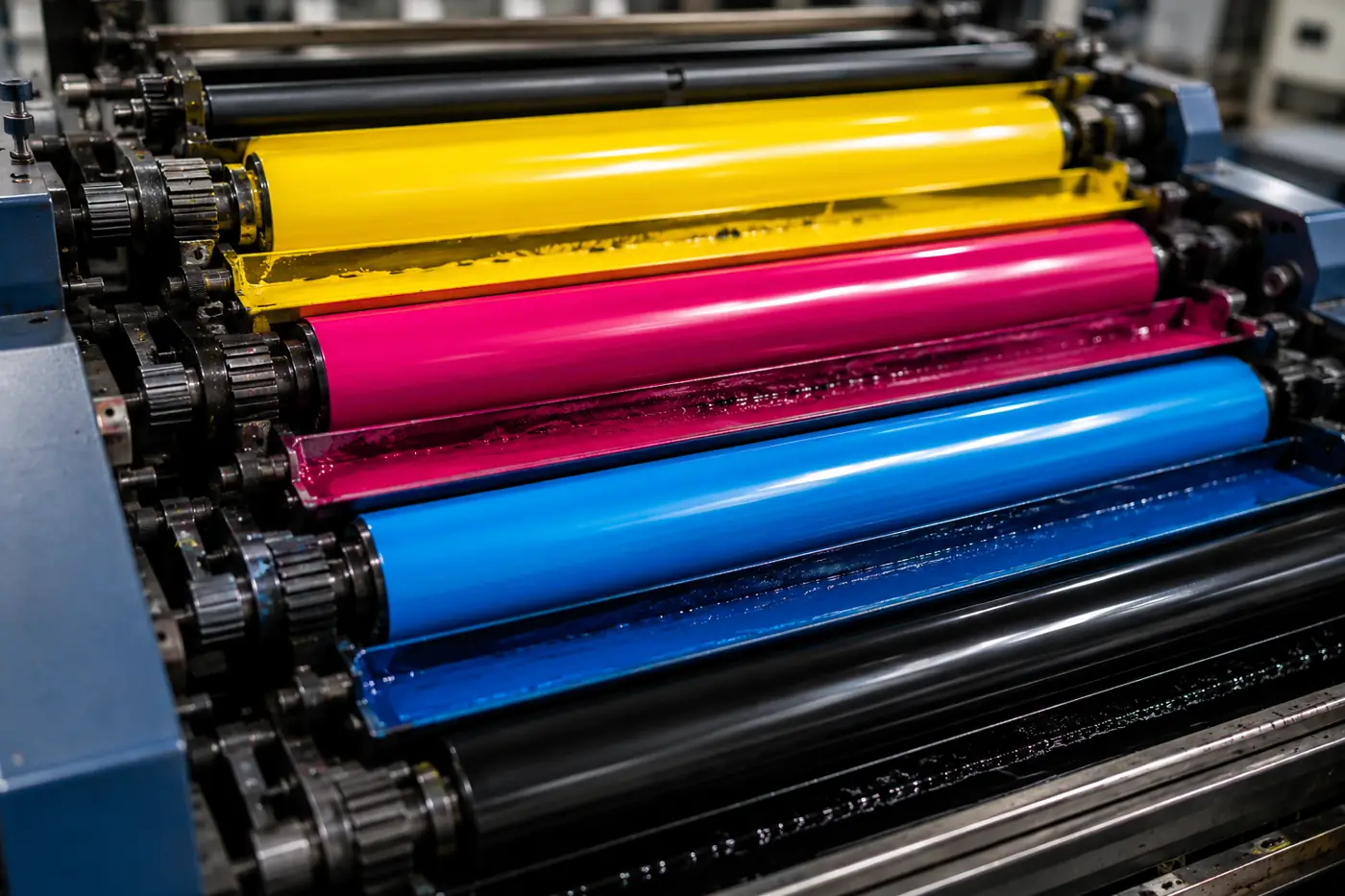
Fine mesh compatibility
Oversized particles block fine screen mesh, so well-milled pigments prevent clogging, pinholing and uneven deposit during high-detail screen printing.
 Pigments by Source From India
Applications
Pigment recommendations for screen printing inks with technical checks and export enquiry support.
Screen printing lays down thick, high-opacity ink films through a mesh, so pigments must have strong tinting strength and clean dispersion without oversized particles that clog fine mesh or cause pinholing. Source From India supplies screen-grade organics for textile, graphic, plastic and industrial work across plastisol, solvent, water and UV systems. Buyers should confirm particle fineness relative to mesh count, opacity and strength for single-pass coverage, solvent and bleed resistance for the substrate, and, in textiles, wash and rub fastness. Consistent grades keep large-format and garment prints uniform run to run.
At a glance
Oversized particles block fine screen mesh, so well-milled pigments prevent clogging, pinholing and uneven deposit during high-detail screen printing.
Thick single-pass films rely on strong, well-covering pigments to deliver bold, saturated color without multiple print strokes.
Plastisol, solvent, water and UV screen inks differ, so pigments must match the vehicle's wetting, cure and bleed-resistance requirements.
Garment prints need pigments with good wash and rub fastness so designs survive repeated laundering without fading or crocking.
Recommended pigments
A starting shortlist of export-grade organic pigments relevant to Pigments for Screen Printing Inks. Open any grade for shade, fastness and packing detail, or send your requirement for a matched recommendation.
Bright green-shade yellow for offset ink and coating applications.
View export grade Red PigmentsQuinacridone magenta for high-performance paints and polymers.
View export grade Pigment PastesReady-to-use paste for fiberglass, FRP panels, and composites.
View export grade Blue PigmentsRed-shade alpha blue with dependable dispersion for inks and coatings.
View export grade Yellow PigmentsDiarylide yellow orange shade for plastics and heat-sensitive systems.
View export gradeExplore more
Answers
Fine mesh screens reproduce detail but clog easily, so pigments must be milled well below the mesh opening. We supply finely dispersed grades that pass cleanly through high-count mesh, preventing pinholes and blocked areas that ruin sharp text and halftone screen work.
Screen printing often aims for bold, opaque color in a single pass, so strong pigments give full coverage without extra strokes. High tinting strength also lets formulators reach target shades economically, which matters for large-format graphics and high-volume garment printing runs.
Yes. Garment prints face washing and abrasion, so pigments need good wash and rub fastness plus compatibility with plastisol or water-based textile binders. We recommend grades proven in textile systems so printed designs stay bright and intact through repeated laundering.
Sometimes, but cure chemistry differs and UV inks require photoinitiator compatibility while plastisol needs heat-cure stability. We advise per system rather than assuming one grade fits all, so screen printers get pigments matched to each ink's cure mechanism and substrate.
Buyer knowledge base
A short, practical brief for procurement and technical teams — how the right pigment grade is matched, documented, packed and shipped from India, and the fastest way to a quotation.
Matched to your substrate, process temperature and fastness targets — not just the colour name.
Shade and strength held to approved reference standards, order after order.
Evaluation samples with documents so QA and R&D approve shade and strength first.
MOQ, lead time, Incoterms and packing agreed up front, before sampling begins.