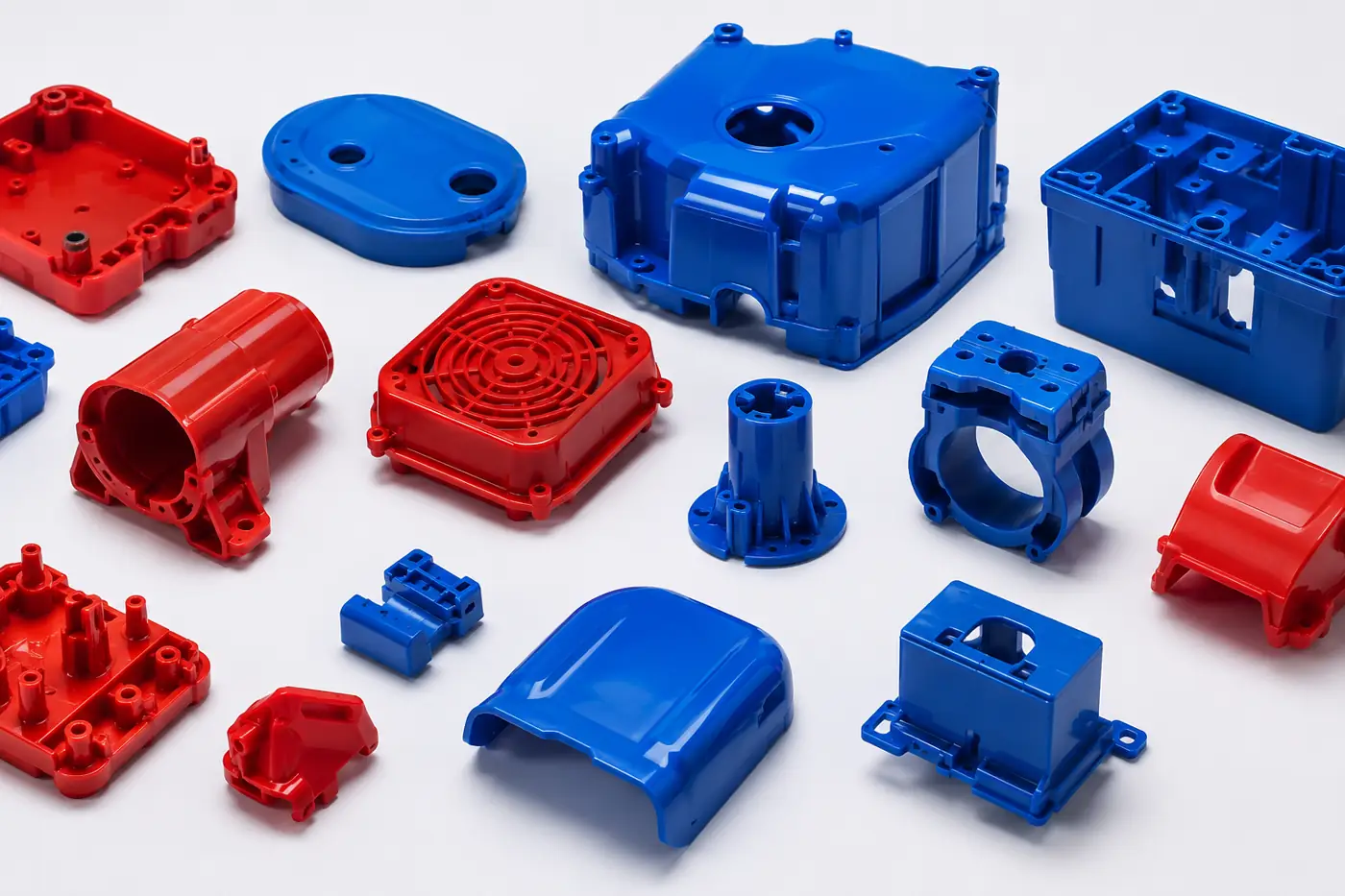
Narrow thermal window
POM degrades and releases formaldehyde if overheated, so pigments must be stable and inert within its tight, sensitive processing temperature range.
 Pigments by Source From India
Applications
Pigment recommendations for pom with technical checks and export enquiry support.
Polyoxymethylene (acetal) is an engineering polymer with a narrow processing window and thermal sensitivity, releasing formaldehyde if overheated, so pigments must be heat-stable, chemically inert toward the polymer's stabilizer system, and free of anything that catalyzes depolymerization. Source From India supplies carefully screened POM-grade organics that avoid acidic or catalytically active impurities. Buyers should confirm stability at acetal processing temperatures, non-interference with the resin's thermal stabilizers, migration resistance in precision molded parts, and dispersion without nucleation effects that distort dimensions. Correct pigment selection protects both color and the mechanical integrity of engineered acetal components.
At a glance
POM degrades and releases formaldehyde if overheated, so pigments must be stable and inert within its tight, sensitive processing temperature range.
Acetal relies on thermal stabilizers, so pigments must not carry acidic or catalytic impurities that trigger depolymerization and part failure.
Some pigments nucleate crystallization and distort dimensions, so grades are screened to protect the tight tolerances of precision acetal parts.
Precision molded POM parts need migration-resistant pigments so color stays locked in gears, clips and mechanical components over service life.
Recommended pigments
A starting shortlist of export-grade organic pigments relevant to Pigments for POM. Open any grade for shade, fastness and packing detail, or send your requirement for a matched recommendation.
Stable epoxy paste for floor coatings and resin systems.
View export grade Green PigmentsYellow-shade green for plastics, coatings, PVC, and export applications.
View export grade Red PigmentsCalcium lake red for printing inks, plastics, and packaging coloration.
View export grade Orange PigmentsBright orange pigment for paint, plastic, and coating systems.
View export grade Pigment PastesSolvent-compatible paste for industrial paints and ink systems.
View export gradeExplore more
Answers
Acetal has a narrow processing window and depolymerizes if destabilized, releasing formaldehyde. Acidic or catalytically active pigment impurities can trigger this. We screen POM grades to be inert and heat-stable, so color does not compromise the resin's thermal stability or the mechanical integrity of molded parts.
Yes. Certain pigments act as nucleating agents, altering crystallization and causing shrinkage or warpage that ruins tight-tolerance parts like gears and clips. We select grades screened for minimal nucleation effect, so dimensional accuracy is preserved in precision-molded acetal components.
POM must stay within a limited temperature range to avoid degradation, so pigments need reliable stability at acetal melt temperatures without excess heat headroom. We recommend grades validated for this sensitive window so parts mold cleanly without discoloration or stabilizer disruption.
We supply grades known to be free of acidic and catalytic impurities that harm POM, and we advise buyers to validate color in their specific stabilized formulation. Share your resin grade and process and we recommend pigments with a proven record in engineering acetal applications.
Buyer knowledge base
A quick orientation for buyers new to Indian pigment supply — what to specify, what to expect and how to move fast.
Target a physical standard or current reference; the lab confirms undertone and tinting strength.
For plasticised and polyolefin systems, grades are chosen to resist blooming and plate-out.
REACH and RoHS declarations and correct HS codes prepared for your market's customs.
Approve shade, strength and dispersion on a sample before any production quantity.